
Advanced Cybersecurity
Systems and Applications
Advanced Cybersecurity
Systems and Applications
Advanced Cybersecurity
Systems and Applications
Decision Time is Emerging from Years in “Stealth Mode”
A Completely New Approach to Cybersecurity, Asset Protection and Security-first Analytics —
Patented Systems that Transform Resource Security at the Center of File Control Systems
Urgent Need
For Decision Time security technologies — on-Site, Cloud, and Hybrid Enterprise
Advancing Code Base
Rapid development in implementation of our technologies and products
Patent Growth
Progress in deep and growing patent portfolio (See summary of patents Here)
Decision Time is seeking funding and industry partners to execute the commercial introduction of its API-based systems
Decision Time is Emerging from Years in
“Stealth Mode”
“Stealth Mode”
A Completely New Approach to Cybersecurity, Asset Protection and Security-first Analytics — Patented Systems that Transform Resource Security at the Center of File Control Systems
Urgent Need
For Decision Time security technologies — on-Site, Cloud, and Hybrid Enterprise
Advancing Code Base
Rapid development in implementation of our technologies and products
Patent Growth
Progress in deep and growing patent portfolio (See summary of patents Here)
Decision Time is seeking funding and industry partners to execute the commercial introduction of its API-based systems
Decision Time is Emerging from Years in “Stealth Mode”
A Completely New Approach to Cybersecurity, Asset Protection and Security-first Analytics —
Patented Systems that Transform Resource Security at the Center of File Control Systems
Urgent Need
For Decision Time security technologies — on-Site, Cloud, and Hybrid Enterprise
Advancing Code Base
Rapid development in implementation of our technologies and products
Patent Growth
Progress in deep and growing patent portfolio (See summary of patents Here)
Decision Time is seeking funding and industry partners to execute the commercial introduction of its API-based systems
An Inconvenient Truth:
Zero Trust Cybersecurity Solutions alone will NOT SOLVE the Cybersecurity Crisis
Cyber attacks are possible because of a fundamental flaw in access control found in all operating systems

ZTOS Changes the Cybersecurity Landscape by Removing the Basic Weakness in Access Control Security
An Inconvenient Truth:
Zero Trust Cybersecurity solutions alone will NOT SOLVE the Cybersecurity Crisis
Cyber attacks are possible because of a fundamental flaw in access control found in all operating systems
File System Operations Must Change
-
All operating systems have this flaw
-
Zero Trust Architectures DO NOT address this security limitation
-
The flood of entries into the cybersecurity ecosystem can only patch this “leaky” roof
- Even complex solutions effectively place towels below this leaky roof — without providing long-term or comprehensive solutions
- This creates a cycle of increasing deployment costs, training overhead and in many cases, create new vulnerabilities
ZTOS Changes the Cybersecurity Landscape by Removing the Basic Weakness in Access Control Security
An Inconvenient Truth:
Zero Trust Cybersecurity solutions alone will NOT SOLVE the Cybersecurity Crisis
Cyber attacks are possible because of a fundamental flaw in access control found in all operating systems
File System Operations Must Change
-
All operating systems have this flaw
-
Zero Trust Architectures DO NOT address this security limitation
-
The flood of entries into the cybersecurity ecosystem can only patch this “leaky” roof
- Even complex solutions effectively place towels below this leaky roof — without providing long-term or comprehensive solutions
- This creates a cycle of increasing deployment costs, training overhead and in many cases, create new vulnerabilities
ZTOS Changes the Cybersecurity Landscape by Removing the Basic Weakness in Access Control Security
Decision Time’s ZTOS System —
Completely New Solution to the Cybersecurity Problem
ZTOS is NOT Another Entry Into the Explosion of Zero Trust Solutions
— ZTOS Introduces a New Type of Security-centered File System
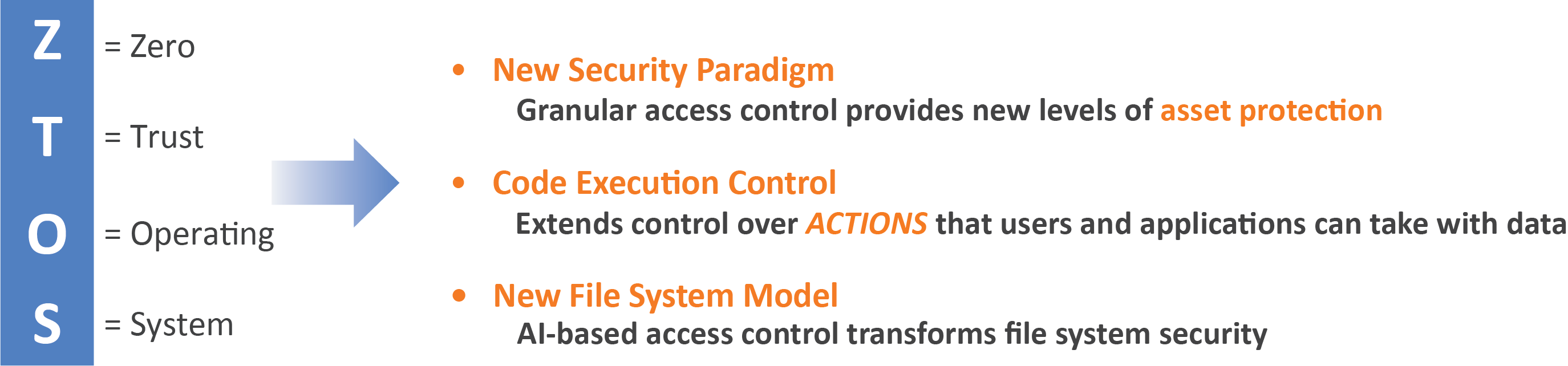
New Security Paradigm
Capability-based Access Control — new levels of asset protection
Code Execution Control
Extends control over ACTIONS that users and applications can take with data
New File System Model
AI-based access control transforms file systems
Decision Time Eliminates the Most Challenging Cyberattacks — Supply Chain, API-based, Ransomware, Insider Attacks, Identity Theft
Decision Time’s ZTOS System —
Completely New Solution to the Cybersecurity Problem
ZTOS is NOT Another Entry Into the Explosion of Zero Trust Solutions
— ZTOS Introduces a New Type of Security-centered File System
New Security Paradigm
Granular access control provides new levels of asset protection
Code Execution Control
Extends control over ACTIONS that users and applications can take with data
New File System Model
AI-based access control transforms file system security
Decision Time Eliminates the Most Challenging Cyberattacks— Supply Chain, API-based, Ransomware, Insider Attacks, Identity Theft
Decision Time’s ZTOS System —
Completely New Solution to the Cybersecurity Problem
ZTOS is NOT Another Entry Into the Explosion of Zero Trust Solutions
— ZTOS Introduces a New Type of Security-centered File System
New Security Paradigm
Granular access control provides new levels of asset protection
Code Execution Control
Extends control over ACTIONS that users and applications can take with data
New File System Model
AI-based access control transforms file system security
Decision Time Eliminates the Most Challenging Cyberattacks— Supply Chain, API-based, Ransomware, Insider Attacks, Identity Theft
How Decision Time’s ZTOS Changes the Security Paradigm
There are 3 Elements Required in Any Computer Action — User, Data and Code Execution
- Current systems can only control 2 of these elements — Users and Data
- Current systems are unable to fully control actions once access to data is granted
- ZTOS exerts fine-grained control over all 3 elements — a new control system over the actions that can be exerted upon data by users and applications
Patented AI-based System Activity Models Redefine how Users and Code Execution Operate upon Data
- ZTOS eliminates root access and super-user privileges through an innovative distributed encryption design that spreads keys and ownership and features continuous authentication
- This architecture removes the main cyberattack vector: privilege escalation and leverage of root access capability
The ZTOS API’s Redefine How File Systems Execute Resource Access and Remove the Main Vulnerabilities That Drive Cyber Attacks
How Decision Time’s ZTOS Changes the Security Paradigm
There are 3 Elements Required in Any Computer Action — User, Data and Code Execution
- Current systems can only control 2 of these elements — Users and Data
- Current systems are unable to fully control actions once access to data is granted
- ZTOS exerts fine-grained control over all 3 elements — a new control system over the actions that can be exerted upon data by users and applications
Patented AI-based System Activity Models Redefine how Users and Code Execution Operate upon Data
- ZTOS eliminates root access and super-user privileges through an innovative distributed encryption design that spreads keys and ownership and features continuous authentication
- This architecture removes the main cyberattack vector: privilege escalation and leverage of root access capability
The ZTOS API’s Redefine How File Systems Execute Resource Access and Remove the Main Vulnerabilities That Drive Cyber Attacks
How Decision Time’s ZTOS Changes the Security Paradigm
There are 3 Elements Required in Any Computer Action — User, Data and Code Execution
- Current systems can only control 2 of these elements — Users and Data
- Current systems are unable to fully control actions once access to data is granted
- ZTOS exerts fine-grained control over all 3 elements — a new control system over the actions that can be exerted upon data by users and applications
Patented AI-based System Activity Models Redefine how Users and Code Execution Operate upon Data
- ZTOS eliminates root access and super-user privileges through an innovative distributed encryption design that spreads keys and ownership and features continuous authentication
- This architecture removes the main cyberattack vector: privilege escalation and leverage of root access capability
The ZTOS API’s Redefine How File Systems Execute Resource Access and Remove the Main Vulnerabilities That Drive Cyber Attacks
FAQs
We understand that we are making bold claims and welcome the opportunity to explain why we do so.
We also look forward to rigorous technical, legal/IP and financial discussions and our plans for distribution of our API’s through established channels through partnerships and licensing.
What does ZTOS stand for and why have you chosen this name?
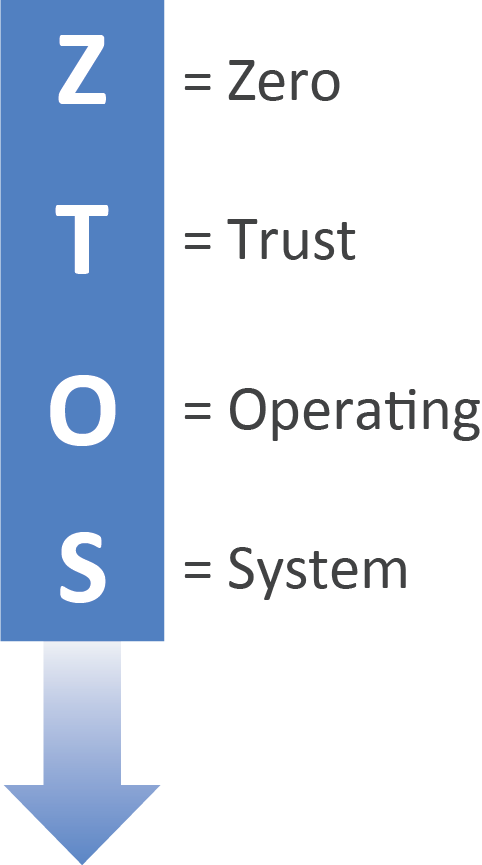
ZTOS, or Zero Trust Operating System embodies the dual principles behind our technology.
- On one hand, we revolutionize file system operations using sophisticated drivers and APIs.
- On the other, Zero Trust principles aren’t mere appendages in our system. Instead, they are integral, baked into every layer from inception.
Our unique AI-based distributed architecture is built on the key Zero Trust tenet: No process, user, or data resource can be trusted by default. Consequently, ZTOS isn’t just a Zero Trust product but a robust, security-focused file system, engineered to fulfill the comprehensive spectrum of Zero Trust specifications.
We welcome technical and functional discussion of these topics.
What unique functionality does ZTOS provide?
ZTOS (Zero Trust Operating System) creates a new type of secure operating environment by applying the principles of Zero Trust across three dimensions simultaneously: data, code/action, and user.
- Unlike conventional systems, ZTOS uniquely controls all three dimensions at once in order to allow or facilitate an action.
- Current systems are two-dimensional and are based on the concept of “defense-in-depth,” which involves multiple layers of security controls — but still only exert control over two of the three dimensions.
This lack of control over all the elements involved in a computer action allows potential breaches, even when they are unintentional. This vulnerability is present in all operating systems, but is eliminated in ZTOS.
Can you illustrate the problem with an example?
Let’s consider a scenario where an authorized employee needs to access a company’s financial records — this involves the user and data dimensions.
- If the employee runs a command to read the data, which is an action executed via code, conventional systems would allow this since the user has the required permissions.
- However, if the same user unintentionally runs a piece of code that corrupts or exports the data without their knowledge — perhaps due to malware or a coding error — traditional systems cannot and do not prevent this action.
This is because these systems cannot simultaneously control and coordinate the three dimensions — user, code, and data.
Are there any other systems similar to ZTOS?
While some elements of ZTOS may exist in various forms elsewhere, no other operating system or cybersecurity solution offers the extensive overhaul of file system security that ZTOS inherently provides.
Could you explain ZTOS in layman’s terms?
Imagine the core of every operating system, spanning cloud, mobile, and desktop platforms. A user receives permissions to read or alter data — a system that’s been pretty much the same since the early UNIX days.
- Picture all computer activities, like ‘edit’ or ‘view’, as a three-piece puzzle involving data, a user, and the execution of a code.
- However, existing access controls, based on these old permission structures, don’t regulate the simultaneous engagement of these three elements once access is granted.
- This simultaneous engagement is what’s needed to control the actions users can perform on the data.
We term this simultaneous control of Data/User/Code as ‘DUC’.
- In ZTOS, no action can happen without the authentication of this DUC puzzle – that is, the pieces must fit. The user must be approved for that action, on that data.
As always, we’re open to further technical and functional discussions on these subjects.
Why does this matter?
One consequence of systems based on outmoded access control architectures is that the operating systems then require all-powerful “super user” accounts and “root access” capabilities. These enable control over any aspect of the system. But these expansive capabilities have many consequences.
- A key goal in all types of cybersecurity attacks is to obtain or escalate privileges to super user or root access level in order to exploit these capabilities.
Unlike traditional systems, ZTOS doesn’t just mitigate these risks – it completely eliminates them, redefining the security paradigm for operating systems.
How do conventional systems address these security vulnerabilities?
Traditional systems attempt to resolve the inherent flaw in all operating systems by deploying a multitude of security solutions (this is the so-called “defense-in-depth” design). These solutions, often sourced from various vendors, must be integrated and maintained across sophisticated, continuously evolving systems.
- This inevitably leads to deployment and compatibility issues, as well as the need for increasingly complex ‘best-practices’ documents, which necessitate additional training.
In general, most security systems — even those that implement the emerging tenets of Zero Trust — focus primarily on verifying permissions and requirements, such as, “Does this user have permission to connect via VPN?” or “Does this device meet the connection requirements?”
- While these checks potentially hinder unauthorized access, they also introduce complex, costly parameters, requiring continual maintenance.
- This can introduce system and user overhead (“friction”), which ZTOS mitigates through its distributed ownership and authentication architecture.
Moreover, a multitude of security solutions exist, including VPNs and anti-virus software. In addition, security measures that address individual data, user, and code/action aspects, like code signing and file encryption, have also been in use for years.
- However, none of these approaches address the central issue — controlling all three dimensions simultaneously to permit or enable an action.
This is the fundamental flaw in all operating systems that is rectified by ZTOS.
Given the vast resources poured into security, why hasn’t another company developed ZTOS?
The solutions offered by ZTOS are not “changes at the edges” or “workarounds” but involve a different approach to file system operations, which effectively addresses the most critical vulnerabilities in current operating systems.
- However, true technological evolution and innovation often emerge from unexpected places, not just the well-established tech giants.
So, the approach to cybersecurity by Decision Time is entirely unique.
Decision Time has adopted an innovative and comprehensive strategy to address cybersecurity issues. These issues, previously handled in a piecemeal fashion, avoid the deeper architectural challenges. To realize this strategy, ZTOS employs a mix of original mathematics, technology and repurposed existing methods deployed in novel ways.
- Such an approach requires long-term vision, patience, and dedication — attributes not commonly associated with startup environments. This necessity explains our years of stealth development and bootstrap operation.
- Our primary mission has been to develop a universally applicable, unassailable security system through an API-based infrastructure.
The result of this effort is a versatile architecture that revolutionizes cybersecurity. This architecture provides an exceptional value proposition by combining powerful solutions with robust IP and patent protection.
What is the current stage of Decision Time’s development?
Decision Time has completed the research and testing phases for ZTOS and our security-focused analytic applications.
- We are presently expanding our code base within a representative system.
- Our approach has allowed us to architect the ZTOS APIs and user interface components to be able to align with the specific requirements of potential distribution partnerships.
We are prepared to complete our code for production and for full-scale deployment via our distribution partners.
What do you mean by AI-driven capabilities in ZTOS?
ZTOS incorporates an array of AI technologies, many of which are the result of the original and innovative work of our founders. In one notable instance, ZTOS deploys a proprietary and unique emergent graph neural network to continuously model system activity as users execute code on data.
Additionally, we utilize Natural Language Processing and sophisticated AI tools, like Large Language Models similar to GPT, to extend our Zero Trust protection to the content within data files, not just the files themselves.
These techniques collectively offer unparalleled security dimensions.
You have been awarded 9 patents and have many more in the pipeline. Please explain.
At Decision Time, we have implemented a “portfolio” strategy that encompasses a broad “omnibus” patent with numerous claim sets. We have prepared new claims and supplemental material that leverage the original IP “priority date” of June 2017. The claims granted to us by the US Patent Office secure a unique intellectual property position in the cybersecurity and analytics fields. The scope and depth of this portfolio sets it apart in our industry.
Why is robust patent protection crucial to your business model?
The strength of our business model, which revolves around high-margin API-based licensing and distribution, hinges on two aspects:
- Our proprietary technology is not only unique but also potent and widely applicable, fulfilling a tangible and urgent market demand.
- Our expansive patent protection safeguards this technology, especially the key components that empower the functionalities of ZTOS.
- Moreover, we’ve been granted extensive protection for various technological pathways that make these solutions feasible, bolstering the security of our original work.
This blend of sought-after technology and substantial IP protection reinforces our value proposition and buttresses our bold business model.
Do you provide financials and revenue modeling?
Yes, we have meticulously prepared financials that detail our revenue streams and expenditures. Upon request, we can provide these financial models along with supplementary materials, such as technical documentation, summaries of our intellectual property, and necessary corporate and legal due diligence documents.
FAQs
We understand that we are making bold claims and welcome the opportunity to explain why we do so.
We also look forward to rigorous technical, legal/IP and financial discussions and our plans for distribution of our API’s through established channels through partnerships and licensing.
What does ZTOS stand for and why have you chosen this name?
ZTOS, or Zero Trust Operating System embodies the dual principles behind our technology.
- On one hand, we revolutionize file system operations using sophisticated drivers and APIs.
- On the other, Zero Trust principles aren’t mere appendages in our system. Instead, they are integral, baked into every layer from inception.
Our unique AI-based distributed architecture is built on the key Zero Trust tenet: No process, user, or data resource can be trusted by default. Consequently, ZTOS isn’t just a Zero Trust product but a robust, security-focused file system, engineered to fulfill the comprehensive spectrum of Zero Trust specifications.
We welcome technical and functional discussion of these topics.
What unique functionality does ZTOS provide?
ZTOS (Zero Trust Operating System) creates a new type of secure operating environment by applying the principles of Zero Trust across three dimensions simultaneously: data, code/action, and user.
- Unlike conventional systems, ZTOS uniquely controls all three dimensions at once in order to allow or facilitate an action.
- Current systems are two-dimensional and are based on the concept of “defense-in-depth,” which involves multiple layers of security controls — but still only exert control over two of the three dimensions.
This lack of control over all the elements involved in a computer action allows potential breaches, even when they are unintentional. This vulnerability is present in all operating systems, but is eliminated in ZTOS.
Can you illustrate the problem with an example?
Let’s consider a scenario where an authorized employee needs to access a company’s financial records — this involves the user and data dimensions.
- If the employee runs a command to read the data, which is an action executed via code, conventional systems would allow this since the user has the required permissions.
- However, if the same user unintentionally runs a piece of code that corrupts or exports the data without their knowledge — perhaps due to malware or a coding error — traditional systems cannot and do not prevent this action.
This is because these systems cannot simultaneously control and coordinate the three dimensions — user, code, and data.
Are there any other systems similar to ZTOS?
While some elements of ZTOS may exist in various forms elsewhere, no other operating system or cybersecurity solution offers the extensive overhaul of file system security that ZTOS inherently provides.
Could you explain ZTOS in layman’s terms?
Imagine the core of every operating system, spanning cloud, mobile, and desktop platforms. A user receives permissions to read or alter data — a system that’s been pretty much the same since the early UNIX days.
- Picture all computer activities, like ‘edit’ or ‘view’, as a three-piece puzzle involving data, a user, and the execution of a code.
- However, existing access controls, based on these old permission structures, don’t regulate the simultaneous engagement of these three elements once access is granted.
- This simultaneous engagement is what’s needed to control the actions users can perform on the data.
We term this simultaneous control of Data/User/Code as ‘DUC’.
- In ZTOS, no action can happen without the authentication of this DUC puzzle – that is, the pieces must fit. The user must be approved for that action, on that data.
As always, we’re open to further technical and functional discussions on these subjects.
Why does this matter?
One consequence of systems based on outmoded access control architectures is that the operating systems then require all-powerful “super user” accounts and “root access” capabilities. These enable control over any aspect of the system. But these expansive capabilities have many consequences.
- A key goal in all types of cybersecurity attacks is to obtain or escalate privileges to super user or root access level in order to exploit these capabilities.
Unlike traditional systems, ZTOS doesn’t just mitigate these risks – it completely eliminates them, redefining the security paradigm for operating systems.
How do conventional systems address these security vulnerabilities?
Traditional systems attempt to resolve the inherent flaw in all operating systems by deploying a multitude of security solutions (this is the so-called “defense-in-depth” design). These solutions, often sourced from various vendors, must be integrated and maintained across sophisticated, continuously evolving systems.
- This inevitably leads to deployment and compatibility issues, as well as the need for increasingly complex ‘best-practices’ documents, which necessitate additional training.
In general, most security systems — even those that implement the emerging tenets of Zero Trust — focus primarily on verifying permissions and requirements, such as, “Does this user have permission to connect via VPN?” or “Does this device meet the connection requirements?”
- While these checks potentially hinder unauthorized access, they also introduce complex, costly parameters, requiring continual maintenance.
- This can introduce system and user overhead (“friction”), which ZTOS mitigates through its distributed ownership and authentication architecture.
Moreover, a multitude of security solutions exist, including VPNs and anti-virus software. In addition, security measures that address individual data, user, and code/action aspects, like code signing and file encryption, have also been in use for years.
- However, none of these approaches address the central issue — controlling all three dimensions simultaneously to permit or enable an action.
This is the fundamental flaw in all operating systems that is rectified by ZTOS.
Given the vast resources poured into security, why hasn’t another company developed ZTOS?
The solutions offered by ZTOS are not “changes at the edges” or “workarounds” but involve a different approach to file system operations, which effectively addresses the most critical vulnerabilities in current operating systems.
- However, true technological evolution and innovation often emerge from unexpected places, not just the well-established tech giants.
So, the approach to cybersecurity by Decision Time is entirely unique.
Decision Time has adopted an innovative and comprehensive strategy to address cybersecurity issues. These issues, previously handled in a piecemeal fashion, avoid the deeper architectural challenges. To realize this strategy, ZTOS employs a mix of original mathematics, technology and repurposed existing methods deployed in novel ways.
- Such an approach requires long-term vision, patience, and dedication — attributes not commonly associated with startup environments. This necessity explains our years of stealth development and bootstrap operation.
- Our primary mission has been to develop a universally applicable, unassailable security system through an API-based infrastructure.
The result of this effort is a versatile architecture that revolutionizes cybersecurity. This architecture provides an exceptional value proposition by combining powerful solutions with robust IP and patent protection.
What is the current stage of Decision Time’s development?
Decision Time has completed the research and testing phases for ZTOS and our security-focused analytic applications.
- We are presently expanding our code base within a representative system.
- Our approach has allowed us to architect the ZTOS APIs and user interface components to be able to align with the specific requirements of potential distribution partnerships.
We are prepared to complete our code for production and for full-scale deployment via our distribution partners.
What do you mean by AI-driven capabilities in ZTOS?
ZTOS incorporates an array of AI technologies, many of which are the result of the original and innovative work of our founders. In one notable instance, ZTOS deploys a proprietary and unique emergent graph neural network to continuously model system activity as users execute code on data.
Additionally, we utilize Natural Language Processing and sophisticated AI tools, like Large Language Models similar to GPT, to extend our Zero Trust protection to the content within data files, not just the files themselves.
These techniques collectively offer unparalleled security dimensions.
You have been awarded 9 patents and have many more in the pipeline. Please explain.
At Decision Time, we have implemented a “portfolio” strategy that encompasses a broad “omnibus” patent with numerous claim sets. We have prepared new claims and supplemental material that leverage the original IP “priority date” of June 2017. The claims granted to us by the US Patent Office secure a unique intellectual property position in the cybersecurity and analytics fields. The scope and depth of this portfolio sets it apart in our industry.
Why is robust patent protection crucial to your business model?
The strength of our business model, which revolves around high-margin API-based licensing and distribution, hinges on two aspects:
- Our proprietary technology is not only unique but also potent and widely applicable, fulfilling a tangible and urgent market demand.
- Our expansive patent protection safeguards this technology, especially the key components that empower the functionalities of ZTOS.
- Moreover, we’ve been granted extensive protection for various technological pathways that make these solutions feasible, bolstering the security of our original work.
This blend of sought-after technology and substantial IP protection reinforces our value proposition and buttresses our bold business model.
Do you provide financials and revenue modeling?
Yes, we have meticulously prepared financials that detail our revenue streams and expenditures. Upon request, we can provide these financial models along with supplementary materials, such as technical documentation, summaries of our intellectual property, and necessary corporate and legal due diligence documents.
FAQs
We understand that we are making bold claims and welcome the opportunity to explain why we do so.
We also look forward to rigorous technical, legal/IP and financial discussions and our plans for distribution of our API’s through established channels through partnerships and licensing.
What does ZTOS stand for and why have you chosen this name?
ZTOS, or Zero Trust Operating System embodies the dual principles behind our technology.
- On one hand, we revolutionize file system operations using sophisticated drivers and APIs.
- On the other, Zero Trust principles aren’t mere appendages in our system. Instead, they are integral, baked into every layer from inception.
Our unique AI-based distributed architecture is built on the key Zero Trust tenet: No process, user, or data resource can be trusted by default. Consequently, ZTOS isn’t just a Zero Trust product but a robust, security-focused file system, engineered to fulfill the comprehensive spectrum of Zero Trust specifications.
We welcome technical and functional discussion of these topics.
What unique functionality does ZTOS provide?
ZTOS (Zero Trust Operating System) creates a new type of secure operating environment by applying the principles of Zero Trust across three dimensions simultaneously: data, code/action, and user.
- Unlike conventional systems, ZTOS uniquely controls all three dimensions at once in order to allow or facilitate an action.
- Current systems are two-dimensional and are based on the concept of “defense-in-depth,” which involves multiple layers of security controls — but still only exert control over two of the three dimensions.
This lack of control over all the elements involved in a computer action allows potential breaches, even when they are unintentional. This vulnerability is present in all operating systems, but is eliminated in ZTOS.
Can you illustrate the problem with an example?
Let’s consider a scenario where an authorized employee needs to access a company’s financial records — this involves the user and data dimensions.
- If the employee runs a command to read the data, which is an action executed via code, conventional systems would allow this since the user has the required permissions.
- However, if the same user unintentionally runs a piece of code that corrupts or exports the data without their knowledge — perhaps due to malware or a coding error — traditional systems cannot and do not prevent this action.
This is because these systems cannot simultaneously control and coordinate the three dimensions — user, code, and data.
Are there any other systems similar to ZTOS?
While some elements of ZTOS may exist in various forms elsewhere, no other operating system or cybersecurity solution offers the extensive overhaul of file system security that ZTOS inherently provides.
Could you explain ZTOS in layman’s terms?
Imagine the core of every operating system, spanning cloud, mobile, and desktop platforms. A user receives permissions to read or alter data — a system that’s been pretty much the same since the early UNIX days.
- Picture all computer activities, like ‘edit’ or ‘view’, as a three-piece puzzle involving data, a user, and the execution of a code.
- However, existing access controls, based on these old permission structures, don’t regulate the simultaneous engagement of these three elements once access is granted.
- This simultaneous engagement is what’s needed to control the actions users can perform on the data.
We term this simultaneous control of Data/User/Code as ‘DUC’.
- In ZTOS, no action can happen without the authentication of this DUC puzzle – that is, the pieces must fit. The user must be approved for that action, on that data.
As always, we’re open to further technical and functional discussions on these subjects.
Why does this matter?
One consequence of systems based on outmoded access control architectures is that the operating systems then require all-powerful “super user” accounts and “root access” capabilities. These enable control over any aspect of the system. But these expansive capabilities have many consequences.
- A key goal in all types of cybersecurity attacks is to obtain or escalate privileges to super user or root access level in order to exploit these capabilities.
Unlike traditional systems, ZTOS doesn’t just mitigate these risks – it completely eliminates them, redefining the security paradigm for operating systems.
How do conventional systems address these security vulnerabilities?
Traditional systems attempt to resolve the inherent flaw in all operating systems by deploying a multitude of security solutions (this is the so-called “defense-in-depth” design). These solutions, often sourced from various vendors, must be integrated and maintained across sophisticated, continuously evolving systems.
- This inevitably leads to deployment and compatibility issues, as well as the need for increasingly complex ‘best-practices’ documents, which necessitate additional training.
In general, most security systems — even those that implement the emerging tenets of Zero Trust — focus primarily on verifying permissions and requirements, such as, “Does this user have permission to connect via VPN?” or “Does this device meet the connection requirements?”
- While these checks potentially hinder unauthorized access, they also introduce complex, costly parameters, requiring continual maintenance.
- This can introduce system and user overhead (“friction”), which ZTOS mitigates through its distributed ownership and authentication architecture.
Moreover, a multitude of security solutions exist, including VPNs and anti-virus software. In addition, security measures that address individual data, user, and code/action aspects, like code signing and file encryption, have also been in use for years.
- However, none of these approaches address the central issue — controlling all three dimensions simultaneously to permit or enable an action.
This is the fundamental flaw in all operating systems that is rectified by ZTOS.
Given the vast resources poured into security, why hasn’t another company developed ZTOS?
The solutions offered by ZTOS are not “changes at the edges” or “workarounds” but involve a different approach to file system operations, which effectively addresses the most critical vulnerabilities in current operating systems.
- However, true technological evolution and innovation often emerge from unexpected places, not just the well-established tech giants.
So, the approach to cybersecurity by Decision Time is entirely unique.
Decision Time has adopted an innovative and comprehensive strategy to address cybersecurity issues. These issues, previously handled in a piecemeal fashion, avoid the deeper architectural challenges. To realize this strategy, ZTOS employs a mix of original mathematics, technology and repurposed existing methods deployed in novel ways.
- Such an approach requires long-term vision, patience, and dedication — attributes not commonly associated with startup environments. This necessity explains our years of stealth development and bootstrap operation.
- Our primary mission has been to develop a universally applicable, unassailable security system through an API-based infrastructure.
The result of this effort is a versatile architecture that revolutionizes cybersecurity. This architecture provides an exceptional value proposition by combining powerful solutions with robust IP and patent protection.
What is the current stage of Decision Time’s development?
Decision Time has completed the research and testing phases for ZTOS and our security-focused analytic applications.
- We are presently expanding our code base within a representative system.
- Our approach has allowed us to architect the ZTOS APIs and user interface components to be able to align with the specific requirements of potential distribution partnerships.
We are prepared to complete our code for production and for full-scale deployment via our distribution partners.
What do you mean by AI-driven capabilities in ZTOS?
ZTOS incorporates an array of AI technologies, many of which are the result of the original and innovative work of our founders. In one notable instance, ZTOS deploys a proprietary and unique emergent graph neural network to continuously model system activity as users execute code on data.
Additionally, we utilize Natural Language Processing and sophisticated AI tools, like Large Language Models similar to GPT, to extend our Zero Trust protection to the content within data files, not just the files themselves.
These techniques collectively offer unparalleled security dimensions.
You have been awarded 9 patents and have many more in the pipeline. Please explain.
At Decision Time, we have implemented a “portfolio” strategy that encompasses a broad “omnibus” patent with numerous claim sets. We have prepared new claims and supplemental material that leverage the original IP “priority date” of June 2017. The claims granted to us by the US Patent Office secure a unique intellectual property position in the cybersecurity and analytics fields. The scope and depth of this portfolio sets it apart in our industry.
Why is robust patent protection crucial to your business model?
The strength of our business model, which revolves around high-margin API-based licensing and distribution, hinges on two aspects:
- Our proprietary technology is not only unique but also potent and widely applicable, fulfilling a tangible and urgent market demand.
- Our expansive patent protection safeguards this technology, especially the key components that empower the functionalities of ZTOS.
- Moreover, we’ve been granted extensive protection for various technological pathways that make these solutions feasible, bolstering the security of our original work.
This blend of sought-after technology and substantial IP protection reinforces our value proposition and buttresses our bold business model.
Do you provide financials and revenue modeling?
Yes, we have meticulously prepared financials that detail our revenue streams and expenditures. Upon request, we can provide these financial models along with supplementary materials, such as technical documentation, summaries of our intellectual property, and necessary corporate and legal due diligence documents.
Overview of Decision Time Patent Portfolio
Decision Time has pursued a comprehensive patent portfolio strategy — starting with a PCT disclosure in (2017), followed by the filing of a large omnibus and series of follow-on patents.
- Follow this link for summaries of these patents and for links to text and extensive claim sets.
- To date, 9 patents in this portfolio have been granted and more have been filed or are in process. Decision Time expects to accelerate the expansion of its portfolio with additional filings.
Omnibus Patent: Recombinant Access Mediation through Assertional Simulation
U.S. Patent Number: 10650313
Granted May 2020
Continuation C01: Control of Computing Processes through Semantic Mediation
U.S. Patent Number: 10936957
Granted March 2021
Continuation C02: Reframing Content within an Independent Ontological Frame through Dereferencing
U.S. Patent Number: 11200499
Granted December 2021
Continuation C03: Iterative Refinement of Criteria for Content-Emergent Discovery and Understanding
U.S. Patent Number: 11361228
Granted June 2022
Continuation C04: ZTOS Core Architecture Components
U.S. Patent Number: 11481643
Granted October 2022
Continuation C05: Use of Indices to Administer Diffusion of Entity Identity
U.S. Patent Number: 11790248
Granted October 2023
Continuation C06: Enhancing Computing Entity Security through Generational Identity Diffusion
U.S. Patent Number: 11710050
Granted July 2023
Continuation C07: Multi-layer Three-Dimensional Security Model based on Semantic Relationships Present among Capabilities of a Plurality of Computing Entities
U.S. Patent Number: 11710051
Granted July 2023
Continuation C08: Three-Dimensional Security Model based on Mediation of Entity-Specific Rights Distributed within Emergent Cryptographically Enchained Covenants
U.S. Patent Number: 11710052
Granted July 2023
Continuation C09: Securing Computing Resources Through Entity Aggregation
Overview of Decision Time Patent Portfolio
Decision Time has pursued a comprehensive patent portfolio strategy — starting with a PCT disclosure in (2017), followed by the filing of a large omnibus and series of follow-on patents.
- Follow this link for summaries of these patents and for links to text and extensive claim sets.
-
To date, 9 patents in this portfolio have been granted and more have been filed or are in process. Decision Time expects to accelerate the expansion of its portfolio with additional filings.
Omnibus Patent: Recombinant Access Mediation through Assertional Simulation
U.S. Patent Number: 10650313
Granted May 2020
Continuation C01: Control of Computing Processes through Semantic Mediation
U.S. Patent Number: 10936957
Granted March 2021
Continuation C02: Reframing Content within an Independent Ontological Frame through Dereferencing
U.S. Patent Number: 11200499
Granted December 2021
Continuation C03: Iterative Refinement of Criteria for Content-Emergent Discovery and Understanding
U.S. Patent Number: 11361228
Granted June 2022
Continuation C04: ZTOS Core Architecture Components
U.S. Patent Number: 11481643
Granted October 2022
Continuation C05: Use of Indices to Administer Diffusion of Entity Identity
U.S. Patent Number: 11790248
Granted October 2023
Continuation C06: Enhancing Computing Entity Security through Generational Identity Diffusion
U.S. Patent Number: 11710050
Granted July 2023
Continuation C07: Multi-layer Three-Dimensional Security Model based on Semantic Relationships Present among Capabilities of a Plurality of Computing Entities
U.S. Patent Number: 11710051
Granted July 2023
Continuation C08: Three-Dimensional Security Model based on Mediation of Entity-Specific Rights Distributed within Emergent Cryptographically Enchained Covenants
U.S. Patent Number: 11710052
Granted July 2023
Continuation C09: Securing Computing Resources Through Entity Aggregation
Overview of Decision Time Patent Portfolio
Decision Time has pursued a comprehensive patent portfolio strategy — starting with a PCT disclosure in (2017), followed by the filing of a large omnibus and series of follow-on patents.
- Follow this link for summaries of these patents and for links to text and extensive claim sets.
- To date, 9 patents in this portfolio have been granted and more have been filed or are in process. Decision Time expects to accelerate the expansion of its portfolio with additional filings.
Omnibus Patent: Recombinant Access Mediation through Assertional Simulation
U.S. Patent Number: 10650313
Granted May 2020
Continuation C01: Control of Computing Processes through Semantic Mediation
U.S. Patent Number: 10936957
Granted March 2021
Continuation C02: Reframing Content within an Independent Ontological Frame through Dereferencing
U.S. Patent Number: 11200499
Granted December 2021
Continuation C03: Iterative Refinement of Criteria for Content-Emergent Discovery and Understanding
U.S. Patent Number: 11361228
Granted June 2022
Continuation C04: ZTOS Core Architecture Components
U.S. Patent Number: 11481643
Granted October 2022
Continuation C05: Use of Indices to Administer Diffusion of Entity Identity
U.S. Patent Number: 11790248
Granted October 2023
Continuation C06: Enhancing Computing Entity Security through Generational Identity Diffusion
U.S. Patent Number: 11710050
Granted July 2023
Continuation C07: Multi-layer Three-Dimensional Security Model based on Semantic Relationships Present among Capabilities of a Plurality of Computing Entities
U.S. Patent Number: 11710051
Granted July 2023
Continuation C08: Three-Dimensional Security Model based on Mediation of Entity-Specific Rights Distributed within Emergent Cryptographically Enchained Covenants
U.S. Patent Number: 11710052
Granted July 2023
Continuation C09: Securing Computing Resources Through Entity Aggregation
About The Founders of Decision Time
The Co-Founders of Decision Time, Dennis Ackerman and Stephen Taylor are serial entrepreneurs with long and rich histories in successfully creating and managing advanced technology enterprises.
-
These partners have a unique synergy with overlapping skills and shared vision that reinforces their core expertise and focus.
-
The strength of the management and technological expertise of this partnership is evident in the planning of the Company’s roadmap as well as its detailed execution.
About The Founders of Decision Time
The Co-Founders of Decision Time, Dennis Ackerman and Stephen Taylor are serial entrepreneurs with long and rich histories in successfully creating and managing advanced technology enterprises.
-
These partners have a unique synergy with overlapping skills and shared vision that reinforces their core expertise and focus.
-
The strength of the management and technological expertise of this partnership is evident in the planning of the Company’s roadmap as well as its detailed execution.
About The Founders of Decision Time
The Co-Founders of Decision Time, Dennis Ackerman and Stephen Taylor are serial entrepreneurs with long and rich histories in successfully creating and managing advanced technology enterprises.
-
These partners have a unique synergy with overlapping skills and shared vision that reinforces their core expertise and focus.
-
The strength of the management and technological expertise of this partnership is evident in the planning of the Company’s roadmap as well as its detailed execution.
Dennis Ackerman
Co-Founder, Chairman of the Board
Mr. Ackerman has decades of experience managing technical projects focused on commercialization of original advanced technologies. He is well-known as a technology strategist and innovator.
A more detailed CV is available upon request
Mr. Ackerman has decades of experience managing technical projects focused on commercialization of original advanced technologies. He is well-known as a technology strategist and innovator.
A more detailed CV is available upon request
-
He founded the Bank of America Entrepreneurial Center at Old Dominion University, a key regional technology incubator supported by Virginia’s Center for Innovative Technology.
-
Mr. Ackerman is regarded as an operations and cost accounting expert. This invaluable expertise is evident in his successful implementation of new methods of cost controls and accounting-based optimization of resources but also in the design of organizations around these principles.
-
He has been the lead resource in the successful development and deployment of key technologies in private and in defense environments.
Dennis Ackerman
Co-Founder, Chairman of the Board
Mr. Ackerman has decades of experience managing technical projects focused on commercialization of original advanced technologies. He is well-known as a technology strategist and innovator.
A more detailed CV is available upon request
-
He founded the Bank of America Entrepreneurial Center at Old Dominion University, a key regional technology incubator supported by Virginia’s Center for Innovative Technology.
-
Mr. Ackerman is regarded as an operations and cost accounting expert. This invaluable expertise is evident in his successful implementation of new methods of cost controls and accounting-based optimization of resources but also in the design of organizations around these principles.
-
He has been the lead resource in the successful development and deployment of key technologies in private and in defense environments.
Dennis Ackerman
Co-Founder, Chairman of the Board
Mr. Ackerman has decades of experience managing technical projects focused on commercialization of original advanced technologies. He is well-known as a technology strategist and innovator.
A more detailed CV is available upon request
-
He founded the Bank of America Entrepreneurial Center at Old Dominion University, a key regional technology incubator supported by Virginia’s Center for Innovative Technology.
-
Mr. Ackerman is regarded as an operations and cost accounting expert. This invaluable expertise is evident in his successful implementation of new methods of cost controls and accounting-based optimization of resources but also in the design of organizations around these principles.
-
He has been the lead resource in the successful development and deployment of key technologies in private and in defense environments.
Stephen Taylor
CEO, Co-Founder and Board Manager
Mr. Taylor is a multi-degreed electrical engineer with extensive experience as the primary technical and senior management resource in the architecture, detailed design and deployment of advanced software systems.
A more detailed CV is available upon request
Mr. Taylor is a multi-degreed electrical engineer with extensive experience as the primary technical and senior management resource in the architecture, detailed design and deployment of advanced software systems.
A more detailed CV is available upon request
As lead technical resource in both entrepreneurial and established companies, he has developed and deployed innovative and award-winning products in many consumer and professional markets throughout the world.
At Decision Time, his brief has included the conception, architecture and design of the Company’s many innovations, but is also responsible for the development of the technological and commercial strategies shaping the Company’s roadmap.
-
These efforts reflect his deep experience and expertise in advanced software architecture and application / system design and in the creation and management of multi-discipline teams to implement and deploy these technologies.
-
One key focus of his work has been in the unification of security and distributed encryption-based systems with advanced emergent and graph-based AI analytic systems — leading edge fields in AI and knowledge systems engineering.
Stephen Taylor
CEO, Co-Founder and Board Manager
Mr. Taylor is a multi-degreed electrical engineer with extensive experience as the primary technical and senior management resource in the architecture, detailed design and deployment of advanced software systems.
A more detailed CV is available upon request
Mr. Taylor is a multi-degreed electrical engineer with extensive experience as the primary technical and senior management resource in the architecture, detailed design and deployment of advanced software systems.
A more detailed CV is available upon request
As lead technical resource in both entrepreneurial and established companies, he has developed and deployed innovative and award-winning products in many consumer and professional markets throughout the world.
At Decision Time, his brief has included the conception, architecture and design of the Company’s many innovations, but is also responsible for the development of the technological and commercial strategies shaping the Company’s roadmap.
-
These efforts reflect his deep experience and expertise in advanced software architecture and application / system design and in the creation and management of multi-discipline teams to implement and deploy these technologies.
-
One key focus of his work has been in the unification of security and distributed encryption-based systems with advanced emergent and graph-based AI analytic systems — leading edge fields in AI and knowledge systems engineering.
Stephen Taylor
CEO, Co-Founder and Board Manager
Mr. Taylor is a multi-degreed electrical engineer with extensive experience as the primary technical and senior management resource in the architecture, detailed design and deployment of advanced software systems.
A more detailed CV is available upon request
As lead technical resource in both entrepreneurial and established companies, he has developed and deployed innovative and award-winning products in many consumer and professional markets throughout the world.
At Decision Time, his brief has included the conception, architecture and design of the Company’s many innovations, but is also responsible for the development of the technological and commercial strategies shaping the Company’s roadmap.
-
These efforts reflect his deep experience and expertise in advanced software architecture and application / system design and in the creation and management of multi-discipline teams to implement and deploy these technologies.
-
One key focus of his work has been in the unification of security and distributed encryption-based systems with advanced emergent and graph-based AI analytic systems — leading edge fields in AI and knowledge systems engineering.
Decision Time Team
Our team members bring specialized skills developed over many years and have contributed key expertise in executing our roadmap.
John Taves
Director of EngineeringJohn Taves
- PNW is a custom software development company headquartered in the USA with a team of full-stack developers. Our Co-Founder, Stephen Taylor, has deep history working with key PNW developers and with John Taves, managing teams, developing advanced software systems and applications.
- Mike Hayner, the other co-Founder of PNW has deep technical and management experience, notably as the lead architect and developer of the Sarbanes-Oxley documentation management system for Credit-Suisse.
- PNW has been in business for 24 years and has developed a long list of products and systems from concept to delivery.
Patti Hamilton
Business Development and Government LiaisonPatti Hamilton
Hamilton Consulting Solutions Corporation (HCSC), founder and President/CEO
- HCSC was established in 2008, HCSC is a Woman-Owned Small Business consulting firm specializing in Proposal and Capture Management. She has been pivotal in the creation and operation of the Corporation from inception.
- Her eminent career started in banking and led her to working for the DOD for over 19 years with the Cruise Missile Tomahawk Program before starting HCSC. Patti was also the Founder and President of a Nonprofit to support the City of Chesapeake, VA.
Steve Winter
Decision Time, LLC Member and Board ManagerSteve Winter
- Mr. Winter is a certified Financial Manager and is currently Managing Director of Edgewater Asset Management, a Virginia investment and wealth management company. After starting his career at Anderson Consulting, Mr. Winter was formerly a Risk Manager at Merrill Lynch and has a background with a high growth Silicon Valley software enterprise.
- Mr. Winter also currently serves as an advisor to various investment firms, businesses, and non-profit organizations.
Charles Cella
Managing Director, StrongForce DesignCharles Cella
- Strong Force, the developer of numerous category-leading IP portfolios, has been a key contributor to our IP and patent and portfolio development strategy.
- Mr. Cella is a widely-recognized innovator and patent strategist, who has created billions of dollars in value by leading his clients through a systematic process for mapping, strengthening, and greatly expanding and commercializing their IP portfolios.
Angela Hatcher
Contract Management and AccountingAngela Hatcher
- C.Angels is a bookkeeping and contract management company with over thirty years’ experience managing both commercial and government small business contracts, bookkeeping, financial analysis, and tax preparation.
- The Company was a key contributor in the development of Decision Time’s “Profitability” software application.
Lynne Mallory
Wealth ManagerLynne Mallory
- Ms. Mallory is a Chartered Financial Analyst (CFA) and currently a Managing Director at Edgewater Asset Management, a Virginia investment and wealth management company.
- She was previously a VP with the Industrial Bank of Japan in New York. She provides key advisory services to various commercial entities and supports various non- profits. Ms. Mallory is a Decision Time LLC Member and participant in all aspects of Decision Time’s initiatives.
Leon Fortin Jr.
NextWave IP Legal Services, LLCLeon Fortin Jr.
- Mr. Fortin is an intellectual property and patent portfolio development expert who has led the creation of valuable patent portfolios for high technology companies ranging from early-stage startups to mainstream consumer product and service providers.
- Mr. Fortin employs a patent portfolio approach that engages client technologies, use cases and ecosystems to capture broad market opportunities that are often missed by single idea approaches.
- Client patent portfolios span a range of technologies including emerging software-orchestrated marketplaces, computer and enterprise-level network security and artificial intelligence-based automated systems.
Your Content Goes Here
Your Content Goes HereYour Content Goes Here
Your Content Goes Here
Rick Anderson
Business DevelopmentRick Anderson
- Mr. Anderson has been a long-standing enterprise systems analyst and business development specialist. His fluency in security in a variety of challenging environments are evident most recently as a Senior Technology Cybersecurity Consultant for True North Consulting and Global Cloud Solutions Manager for Sprint/SoftBank.
- Formerly Vice President of Sales/Marketing and Operations -NCS/Siemens AG US Division for 17yrs. Annual multi-million-dollar revenue responsibility through the sale of telecommunications applications for GSA Federal, State, Local Government and Commercial business hardware and software in the United States and Canada
Decision Time Team
Our team members bring specialized skills developed over many years and have contributed key expertise in executing our roadmap.
John Taves
Director of EngineeringJohn Taves
- PNW is a custom software development company headquartered in the USA with a team of full-stack developers. Our Co-Founder, Stephen Taylor, has deep history working with key PNW developers and with John Taves, managing teams, developing advanced software systems and applications.
- Mike Hayner, the other co-Founder of PNW has deep technical and management experience, notably as the lead architect and developer of the Sarbanes-Oxley documentation management system for Credit-Suisse.
- PNW has been in business for 24 years and has developed a long list of products and systems from concept to delivery.
Patti Hamilton
Business Development and Government LiaisonPatti Hamilton
Hamilton Consulting Solutions Corporation (HCSC), founder and President/CEO
-
HCSC was established in 2008, HCSC is a Woman-Owned Small Business consulting firm specializing in Proposal and Capture Management. She has been pivotal in the creation and operation of the Corporation from inception.
-
Her eminent career started in banking and led her to working for the DOD for over 19 years with the Cruise Missile Tomahawk Program before starting HCSC. Patti was also the Founder and President of a Nonprofit to support the City of Chesapeake, VA.
Steve Winter
Decision Time, LLC Member and Board ManagerSteve Winter
- Mr. Winter is a certified Financial Manager and is currently Managing Director of Edgewater Asset Management, a Virginia investment and wealth management company. After starting his career at Anderson Consulting, Mr. Winter was formerly a Risk Manager at Merrill Lynch and has a background with a high growth Silicon Valley software enterprise.
- Mr. Winter also currently serves as an advisor to various investment firms, businesses, and non-profit organizations.
Charles Cella
Managing Director, StrongForce DesignCharles Cella
- Strong Force, the developer of numerous category-leading IP portfolios, has been a key contributor to our IP and patent and portfolio development strategy.
- Mr. Cella is a widely-recognized innovator and patent strategist, who has created billions of dollars in value by leading his clients through a systematic process for mapping, strengthening, and greatly expanding and commercializing their IP portfolios.
Angela Hatcher
Contract Management and AccountingAngela Hatcher
- C.Angels is a bookkeeping and contract management company with over thirty years’ experience managing both commercial and government small business contracts, bookkeeping, financial analysis, and tax preparation.
- The Company was a key contributor in the development of Decision Time’s “Profitability” software application.
Lynne Mallory
Wealth ManagerLynne Mallory
- Ms. Mallory is a Chartered Financial Analyst (CFA) and currently a Managing Director at Edgewater Asset Management, a Virginia investment and wealth management company.
- She was previously a VP with the Industrial Bank of Japan in New York. She provides key advisory services to various commercial entities and supports various non- profits. Ms. Mallory is a Decision Time LLC Member and participant in all aspects of Decision Time’s initiatives.
Leon Fortin Jr.
NextWave IP Legal Services, LLCLeon Fortin Jr.
- Mr. Fortin is an intellectual property and patent portfolio development expert who has led the creation of valuable patent portfolios for high technology companies ranging from early-stage startups to mainstream consumer product and service providers.
- Mr. Fortin employs a patent portfolio approach that engages client technologies, use cases and ecosystems to capture broad market opportunities that are often missed by single idea approaches.
- Client patent portfolios span a range of technologies including emerging software-orchestrated marketplaces, computer and enterprise-level network security and artificial intelligence-based automated systems.
Your Content Goes Here
Your Content Goes HereYour Content Goes Here
Your Content Goes Here
Rick Anderson
Business DevelopmentRick Anderson
- Mr. Anderson has been a long-standing enterprise systems analyst and business development specialist. His fluency in security in a variety of challenging environments are evident most recently as a Senior Technology Cybersecurity Consultant for True North Consulting and Global Cloud Solutions Manager for Sprint/SoftBank.
- Formerly Vice President of Sales/Marketing and Operations -NCS/Siemens AG US Division for 17yrs. Annual multi-million-dollar revenue responsibility through the sale of telecommunications applications for GSA Federal, State, Local Government and Commercial business hardware and software in the United States and Canada
Decision Time Team
Our team members bring specialized skills developed over many years and have contributed key expertise in executing our roadmap.
John Taves
Pacific Northwest Software — CEO, Co-FounderJohn Taves
- PNW is a custom software development company headquartered in the USA with a team of full-stack developers. Our Co-Founder, Stephen Taylor, has deep history working with key PNW developers and with John Taves, managing teams, developing advanced software systems and applications.
- Mike Hayner, the other co-Founder of PNW has deep technical and management experience, notably as the lead architect and developer of the Sarbanes-Oxley documentation management system for Credit-Suisse.
- PNW has been in business for 24 years and has developed a long list of products and systems from concept to delivery.
Patti Hamilton
Business Development and Government LiaisonPatti Hamilton
Hamilton Consulting Solutions Corporation (HCSC), founder and President/CEO
- HCSC was established in 2008, HCSC is a Woman-Owned Small Business consulting firm specializing in Proposal and Capture Management. She has been pivotal in the creation and operation of the Corporation from inception.
- Her eminent career started in banking and led her to working for the DOD for over 19 years with the Cruise Missile Tomahawk Program before starting HCSC. Patti was also the Founder and President of a Nonprofit to support the City of Chesapeake, VA.
Steve Winter
Decision Time, LLC Member and Board ManagerSteve Winter
- Mr. Winter is a certified Financial Manager and is currently Managing Director of Edgewater Asset Management, a Virginia investment and wealth management company. After starting his career at Anderson Consulting, Mr. Winter was formerly a Risk Manager at Merrill Lynch and has a background with a high growth Silicon Valley software enterprise.
- Mr. Winter also currently serves as an advisor to various investment firms, businesses, and non-profit organizations.
Charles Cella
StrongForce Design — Managing DirectorCharles Cella
- Strong Force, the developer of numerous category-leading IP portfolios, has been a key contributor to our IP and patent and portfolio development strategy.
- Mr. Cella is a widely-recognized innovator and patent strategist, who has created billions of dollars in value by leading his clients through a systematic process for mapping, strengthening, and greatly expanding and commercializing their IP portfolios.
Angela Hatcher
Contract Management and AccountingAngela Hatcher
- C.Angels is a bookkeeping and contract management company with over thirty years’ experience managing both commercial and government small business contracts, bookkeeping, financial analysis, and tax preparation.
- The Company was a key contributor in the development of Decision Time’s “Profitability” software application.
Lynne Mallory
Wealth ManagerLynne Mallory
- Ms. Mallory is a Chartered Financial Analyst (CFA) and currently a Managing Director at Edgewater Asset Management, a Virginia investment and wealth management company.
- She was previously a VP with the Industrial Bank of Japan in New York. She provides key advisory services to various commercial entities and supports various non- profits. Ms. Mallory is a Decision Time LLC Member and participant in all aspects of Decision Time’s initiatives.
Leon Fortin Jr.
NextWave IP Legal Services, LLCLeon Fortin Jr.
- Mr. Fortin is an intellectual property and patent portfolio development expert who has led the creation of valuable patent portfolios for high technology companies ranging from early-stage startups to mainstream consumer product and service providers.
- Mr. Fortin employs a patent portfolio approach that engages client technologies, use cases and ecosystems to capture broad market opportunities that are often missed by single idea approaches.
- Client patent portfolios span a range of technologies including emerging software-orchestrated marketplaces, computer and enterprise-level network security and artificial intelligence-based automated systems.
Rick Anderson
Business DevelopmentRick Anderson
- Mr. Anderson has been a long-standing enterprise systems analyst and business development specialist. His fluency in security in a variety of challenging environments are evident most recently as a Senior Technology Cybersecurity Consultant for True North Consulting and Global Cloud Solutions Manager for Sprint/SoftBank.
- Formerly Vice President of Sales/Marketing and Operations -NCS/Siemens AG US Division for 17yrs. Annual multi-million-dollar revenue responsibility through the sale of telecommunications applications for GSA Federal, State, Local Government and Commercial business hardware and software in the United States and Canada
Decision Time Board of Advisors
Our Board of Advisors also contribute key skills – these advisors are at the top of their professions and provide the Company with valuable insight and expertise.
Karen R. Jackson
Karen R. Jackson
- Ms. Karen Jackson is an accomplished technology and innovation executive. Currently serving as the Founder and CEO of Apogee Strategic Partners, LLC, she and her team provide consulting and advisory services nationally to companies, states, higher-education institutions, governmental entities, and non-profits.
- Her areas of specialization include innovation, broadband, workforce planning, policy, and deployment, autonomy, cybersecurity, logistics, and technology-based economic development, including smart community development.
- Ms. Jackson served as Virginia’s Secretary of Technology from 2014 to 2019, where she oversaw the Commonwealth’s IT infrastructure and technology-based economic development initiatives.
Brian D Sims
Attorney, Sims and CampbellBrian D Sims
- A strategic-thinking, corporate attorney and business negotiator with over 20 years of experience advising clients both in-house (in private and public corporations) and in major U.S. and global law firms.
- Experience with complex commercial contracts, corporate finance, corporate governance, organizational design, securities laws compliance, mergers and acquisitions, employment law and equity compensation.
- Among previous positions, Senior Director, Associate General Counsel, PayPal. JD — Harvard Law School
John B. White
PhD — Applied StatisticsJohn B. White
- Dr. White has had a distinguished career advising Fortune 50 companies on high stakes decisions.
- He founded Marketing and Planning Systems (MaPS) in 1994, providing consulting services based on advanced and original analytics applied to large complex data sets.
- His innovative analytic models have been used to inform client’s capital investments, new product design, pricing strategies, demand forecasting, and customer targeting strategies.
J. Lindsey Flexner
PhD, Dupont FellowJ. Lindsey Flexner
- Dr. Flexner is an accomplished and published research scientist who served as a key innovator in the development and deployment of key agricultural products, original products that have generated billions in sales for DuPont.
- Prior to his accession to DuPont Fellow, he served as a Senior Research Manager and Product Development Manager and served as a research scientist for the U.S. Department of Agriculture.
- Dr. Flexner has contributed his deep understanding of the practical challenges posed by the continuously increasing flood of data and he has contributed to development of next-gen analytic and data management tools.
Mark Robinson
System Architect / AnalystMark Robinson
- Mr. Robinson is deeply experienced software architect and developer with decades of experience in the development and deployment of mission critical transaction and trading platforms.
- He served as the Chicago Mercantile Exchange (CME) Director of Architecture for the CME Match Engine team as well as in other senior software development and deployment capacities.
- The futures match engine was completely re- architected and re-developed over a period of years under his direction, with patents granted for the new order matching technique.
Stephen CuUnjieng
Financial AdvisorStephen CuUnjieng
- As Senior Managing Director, Mr. CuUnjieng opened the Asia office for Evercore Partners in NYC and was the key manager driving its successful and profitable M&A Division. He retired from Evercore in March of 2022.
- Among many accomplishments, he advised a client that successfully merged with a SPAC in 2021. His distinguished career includes roles as Vice Chairman for Macquarie Group, Managing Director for Merrill Lynch’s Power and Energy Division in Asia, and as a Director for Salomon Brothers in Hong Kong.
- Mr. CuUnjieng is serving as an Advisor and Board Member from small to very large companies.
Peter Bresnan
Peter Bresnan
- Mr. Bresnan is a well-regarded attorney and expert in corporate governance, securities laws and related matters. He served as Deputy Director of the Enforcement Division of the U.S. Securities and Exchange Commission.
- He entered private practice as a Partner with Simpson Thacher & Bartlett LLP (Washington D.C.), served as Senior Advisor to the Director of the Enforcement Division of the Public Company Accounting Oversight Board (PCAOB) and as the Global Head of Litigation and Investigations at EFG Bank in Zurich, Switzerland.
Your Content Goes Here
Your Content Goes HereYour Content Goes Here
Your Content Goes HereMatthew Shanahan
Financial and Corporate StructureMatthew Shanahan
- Mr. Shanahan is a Managing Director at Marathon Capital with decades of experience structuring complex corporate transactions, including financial and tax advantageous syndications.
- He currently specializes in the solar and wind energy sectors. He has formerly held senior investment banking positions at the CIT Group, Newcourt Credit Group, Bank of America Leasing and Capital Group, and the Deerpath Group.
Decision Time Board of Advisors
Our Board of Advisors also contribute key skills – these advisors are at the top of their professions and provide the Company with valuable insight and expertise.
Karen R. Jackson
Karen R. Jackson
- Ms. Karen Jackson is an accomplished technology and innovation executive. Currently serving as the Founder and CEO of Apogee Strategic Partners, LLC, she and her team provide consulting and advisory services nationally to companies, states, higher-education institutions, governmental entities, and non-profits.
- Her areas of specialization include innovation, broadband, workforce planning, policy, and deployment, autonomy, cybersecurity, logistics, and technology-based economic development, including smart community development.
- Ms. Jackson served as Virginia’s Secretary of Technology from 2014 to 2019, where she oversaw the Commonwealth’s IT infrastructure and technology-based economic development initiatives.
Brian D Sims
Attorney, Sims and CampbellBrian D Sims
- A strategic-thinking, corporate attorney and business negotiator with over 20 years of experience advising clients both in-house (in private and public corporations) and in major U.S. and global law firms.
- Experience with complex commercial contracts, corporate finance, corporate governance, organizational design, securities laws compliance, mergers and acquisitions, employment law and equity compensation.
- Among previous positions, Senior Director, Associate General Counsel, PayPal. JD — Harvard Law School
John B. White
PhD — Applied StatisticsJohn B. White
- Dr. White has had a distinguished career advising Fortune 50 companies on high stakes decisions.
- He founded Marketing and Planning Systems (MaPS) in 1994, providing consulting services based on advanced and original analytics applied to large complex data sets.
- His innovative analytic models have been used to inform client’s capital investments, new product design, pricing strategies, demand forecasting, and customer targeting strategies.
J. Lindsey Flexner
PhD, Dupont FellowJ. Lindsey Flexner
- Dr. Flexner is an accomplished and published research scientist who served as a key innovator in the development and deployment of key agricultural products, original products that have generated billions in sales for DuPont.
- Prior to his accession to DuPont Fellow, he served as a Senior Research Manager and Product Development Manager and served as a research scientist for the U.S. Department of Agriculture.
- Dr. Flexner has contributed his deep understanding of the practical challenges posed by the continuously increasing flood of data and he has contributed to development of next-gen analytic and data management tools.
Mark Robinson
System Architect / AnalystMark Robinson
- Mr. Robinson is deeply experienced software architect and developer with decades of experience in the development and deployment of mission critical transaction and trading platforms.
- He served as the Chicago Mercantile Exchange (CME) Director of Architecture for the CME Match Engine team as well as in other senior software development and deployment capacities.
- The futures match engine was completely re- architected and re-developed over a period of years under his direction, with patents granted for the new order matching technique.
Stephen CuUnjieng
Financial AdvisorStephen CuUnjieng
- As Senior Managing Director, Mr. CuUnjieng opened the Asia office for Evercore Partners in NYC and was the key manager driving its successful and profitable M&A Division. He retired from Evercore in March of 2022.
- Among many accomplishments, he advised a client that successfully merged with a SPAC in 2021. His distinguished career includes roles as Vice Chairman for Macquarie Group, Managing Director for Merrill Lynch’s Power and Energy Division in Asia, and as a Director for Salomon Brothers in Hong Kong.
- Mr. CuUnjieng is serving as an Advisor and Board Member from small to very large companies.
Peter Bresnan
Peter Bresnan
- Mr. Bresnan is a well-regarded attorney and expert in corporate governance, securities laws and related matters. He served as Deputy Director of the Enforcement Division of the U.S. Securities and Exchange Commission.
- He entered private practice as a Partner with Simpson Thacher & Bartlett LLP (Washington D.C.), served as Senior Advisor to the Director of the Enforcement Division of the Public Company Accounting Oversight Board (PCAOB) and as the Global Head of Litigation and Investigations at EFG Bank in Zurich, Switzerland.
Your Content Goes Here
Your Content Goes HereYour Content Goes Here
Your Content Goes HereMatthew Shanahan
Financial and Corporate StructureMatthew Shanahan
- Mr. Shanahan is a Managing Director at Marathon Capital with decades of experience structuring complex corporate transactions, including financial and tax advantageous syndications.
- He currently specializes in the solar and wind energy sectors. He has formerly held senior investment banking positions at the CIT Group, Newcourt Credit Group, Bank of America Leasing and Capital Group, and the Deerpath Group.
Decision Time Board of Advisors
Our Board of Advisors also contribute key skills – these advisors are at the top of their professions and provide the Company with valuable insight and expertise.
Karen R. Jackson
Karen R. Jackson
- Ms. Karen Jackson is an accomplished technology and innovation executive. Currently serving as the Founder and CEO of Apogee Strategic Partners, LLC, she and her team provide consulting and advisory services nationally to companies, states, higher-education institutions, governmental entities, and non-profits.
- Her areas of specialization include innovation, broadband, workforce planning, policy, and deployment, autonomy, cybersecurity, logistics, and technology-based economic development, including smart community development.
- Ms. Jackson served as Virginia’s Secretary of Technology from 2014 to 2019, where she oversaw the Commonwealth’s IT infrastructure and technology-based economic development initiatives.
Brian D Sims
Attorney, Sims and CampbellBrian D Sims
- A strategic-thinking, corporate attorney and business negotiator with over 20 years of experience advising clients both in-house (in private and public corporations) and in major U.S. and global law firms.
- Experience with complex commercial contracts, corporate finance, corporate governance, organizational design, securities laws compliance, mergers and acquisitions, employment law and equity compensation.
- Among previous positions, Senior Director, Associate General Counsel, PayPal. JD — Harvard Law School
John B. White
PhD — Applied StatisticsJohn B. White
- Dr. White has had a distinguished career advising Fortune 50 companies on high stakes decisions.
- He founded Marketing and Planning Systems (MaPS) in 1994, providing consulting services based on advanced and original analytics applied to large complex data sets.
- His innovative analytic models have been used to inform client’s capital investments, new product design, pricing strategies, demand forecasting, and customer targeting strategies.
J. Lindsey Flexner
PhD, Dupont FellowJ. Lindsey Flexner
- Dr. Flexner is an accomplished and published research scientist who served as a key innovator in the development and deployment of key agricultural products, original products that have generated billions in sales for DuPont.
- Prior to his accession to DuPont Fellow, he served as a Senior Research Manager and Product Development Manager and served as a research scientist for the U.S. Department of Agriculture.
- Dr. Flexner has contributed his deep understanding of the practical challenges posed by the continuously increasing flood of data and he has contributed to development of next-gen analytic and data management tools.
Mark Robinson
System Architect / AnalystMark Robinson
- Mr. Robinson is deeply experienced software architect and developer with decades of experience in the development and deployment of mission critical transaction and trading platforms.
- He served as the Chicago Mercantile Exchange (CME) Director of Architecture for the CME Match Engine team as well as in other senior software development and deployment capacities.
- The futures match engine was completely re- architected and re-developed over a period of years under his direction, with patents granted for the new order matching technique.
Stephen CuUnjieng
Financial AdvisorStephen CuUnjieng
- As Senior Managing Director, Mr. CuUnjieng opened the Asia office for Evercore Partners in NYC and was the key manager driving its successful and profitable M&A Division. He retired from Evercore in March of 2022.
- Among many accomplishments, he advised a client that successfully merged with a SPAC in 2021. His distinguished career includes roles as Vice Chairman for Macquarie Group, Managing Director for Merrill Lynch’s Power and Energy Division in Asia, and as a Director for Salomon Brothers in Hong Kong.
- Mr. CuUnjieng is serving as an Advisor and Board Member from small to very large companies.
Peter Bresnan
Peter Bresnan
- Mr. Bresnan is a well-regarded attorney and expert in corporate governance, securities laws and related matters. He served as Deputy Director of the Enforcement Division of the U.S. Securities and Exchange Commission.
- He entered private practice as a Partner with Simpson Thacher & Bartlett LLP (Washington D.C.), served as Senior Advisor to the Director of the Enforcement Division of the Public Company Accounting Oversight Board (PCAOB) and as the Global Head of Litigation and Investigations at EFG Bank in Zurich, Switzerland.
Matthew Shanahan
Financial and Corporate StructureMatthew Shanahan
- Mr. Shanahan is a Managing Director at Marathon Capital with decades of experience structuring complex corporate transactions, including financial and tax advantageous syndications.
- He currently specializes in the solar and wind energy sectors. He has formerly held senior investment banking positions at the CIT Group, Newcourt Credit Group, Bank of America Leasing and Capital Group, and the Deerpath Group.

